
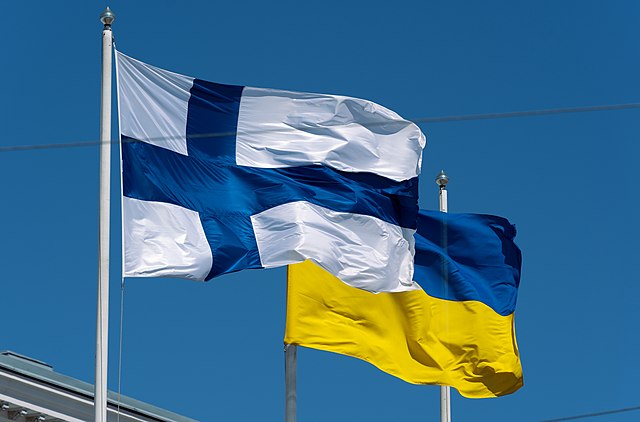

Finland and Ukraine flags in Helsinki, Finland. June 13, 2022. Photo by Santeri Viinamäki. Wikimedia Commons. No changes made. View license here.
By Erlin Trifoni
Introduction
What does the administration of the refugee crisis in Finland tell us about the strengths and weaknesses of its immigration and integration system? How does the governance of the phenomenon intersect with the foreign policy of Helsinki? This report—which relies on anonymous interviews with two government officials from the Ministry of Interior (MoI), three academics and an expert from Cultura Foundation (a Finnish organization that seeks to promote the integration and inclusion of the Russian-speaking population in Finland)—aims to analyze Finland’s response to the Ukrainian refugee crisis in order to further understand the strengths and limits in the administration and governance of the phenomenon. Concurrently, this investigation looks at the foreign policy ramifications embedded in the management of the refugee crisis.
Finnish authorities and political elites have shown remarkable dynamism in responding to regional geopolitical changes, such as the dissolution of the Soviet Union and the formal participation in the European Project through European Union (EU) membership. They have remarked on this peculiar feature of Finnish foreign policy by rapidly changing their stance towards North Atlantic Treaty Organization (NATO) membership when Russia invaded Ukraine on February 24, 2022. The substantial influx of Ukrainian refugees escaping the war and Russian citizens escaping the forced mobilization imposed by Putin’s regime have raised questions about how the Finnish state should govern this phenomenon from an immigration perspective as well as security perspective. This paper argues that the response of Finland’s immigration policy to the Russian invasion of Ukraine should be centred on the sustainable integration of Ukrainian refugees into the economic and social dynamics of the country by capitalizing on favourable labour needs and positive public sentiments surrounding Ukrainian refugees. Furthermore, the Finnish government should press for a common EU strategy to solve the issue of Russian citizens escaping conscription. At the same time, the development of a humanitarian visa program for such migrants might play an important role in reducing consolidated negative attitudes towards russophones while providing a boost in the ability of the government to successfully integrate newcomers and already-present Russian-speaking immigrants in Finland. Concurrently, in making a decision about whether or not to grant refugee status to Russian citizens who are avoiding being drafted into the war, Finland must also consider domestic frictions that the closed interactions between Russian and Ukrainian citizens may produce as a consequence of the ongoing conflict; it must also consider the scars that will be left in the years following the termination of the war, whenever that might be. Lastly, this report analyzes the administration of services for Ukrainian refugees and subsequently claims that deficiencies in service provisions indicate a need to strengthen the engagement between the public sector and private entities in order to pave the way for the bridging of the gap between limited state capacity and high demand for access to social services.
Ukrainian Immigrants in Finland
One of the most pressing, long-term developments that the Finnish government has to address is the establishment of a suitable, permanent settlement plan for those Ukrainian refugees intending to remain in the Nordic country. According to a public survey of 2,136 participants commissioned by the Finnish MoI regarding the situation of Ukrainian refugees residing in Finland, about 27% had no plans to move back to Ukraine, and roughly 40% of those surveyed remained open about all prospects.[i] The proactiveness of the Finnish government in supporting Ukrainian refugees and the language used in MoI press releases regarding employment patterns of these refugees reveal a preliminary intention to allow permanent settlement for those Ukrainian refugees intending to stay even after the conclusion of the war, although no formal decision has been made. For instance, the MoI has explicitly stated that Ukrainians will form a large immigrant group in the country regardless of how and when the war ends. Hence, rather than constructing an argument in favour of a potential exploration of permanent settlement venues for them—as such a determination seems to have already been informally made by the Finnish Government—the focus of this section revolves around identifying ways to facilitate the labour and social integration of Ukrainian citizens in the Nordic country. This is an aspect that remains critical due to domestic market challenges and the need to rapidly integrate a conspicuous number of immigrants in order to avoid long-term social spending and rapidly stimulate their economic participation.
Moreover, the immigration policy of Finland in response to the exodus of Ukrainian refugees and Russian migrants should be developed while taking into account labour market dynamics, domestic demographic features, and public sentiment. The successful formulation of valid immigration policies requires, above all, an insulation of the process from populist discourses. However, immigration policy is often the product of a compromise between what should be done and what can be done; a process that is also highly susceptible to public opinion variations, all of which suggests that policymaking based on strictly pragmatic considerations of the phenomenon remains difficult, albeit desirable, to achieve.
Hence, it remains imperative to take into account the general public’s reception of migration policies. In this realm, the attitudes of Finns towards immigration changed positively, mainly in response to the openness of the Finnish government in welcoming refugees arriving from the former Yugoslavia and war-torn Somalia during the 90s. This influx of refugees into the Nordic country was the most rapid increase of any EU Member State at the time. However, during the recession of 1993, the general perception about immigrants among the native population deteriorated substantially, suggesting that public support towards immigration also correlates with domestic economic performances.[ii] The differences in terms of wages and unemployment rate for immigrants from the former Yugoslavia, stabilized at 52-58%. At the same time, that of refugees from Iraq, Somalia, Iran, was considerably lower at 20-26%.[iii] Hence, it is possible to argue that Ukrainians and Russians would predictably enjoy higher long-term labour market integration rates, in line with those from the former Yugoslavia who settled in the country at the end of the 90s.
Additionally, a recent survey from the Finnish Business Forum (EVA) on attitudes and values revealed that, for the first time ever, the majority of Finns (55%) hold a favourable view regarding the facilitation of migration as a response to the aging of the population and labour shortages. Even 60% of those voting for the far-right party “True Finns” believed that highly skilled immigrants are beneficial to the Finnish economy.[iv] What this new and unprecedented data on public sentiment about immigration reveals is a generalized support of the phenomenon and a relatively strong understanding of its benefits. Such revelations could also explain the 72% employment rate among immigrants—an increase of 8% from 2020—which is the highest rate ever recorded in the country.[v] An enhanced awareness of the benefits of immigration may facilitate the integration of immigrants into the domestic job market. However, this preliminary conclusion requires further monitoring and data gathering, as it is not sufficiently clear if such changes in employment among the immigrant population are the result of temporary or permanent trends. Nevertheless, the data provided are an encouraging manifestation of the current condition of the Finnish job market and of the propensity of the native population to facilitate the incorporation of foreign workers into domestic labour dynamics. This may indicate that the integration of Ukrainian and Russian immigrants could be facilitated by favourable labour and societal conditions, should the government capitalize on them.
Furthermore, the issue of low-skilled labourers must also be discussed in more detail, as it seems to have been neglected in the domestic political discourse despite representing another sector of the Finnish labour market that is lacking workers. In particular, low-skilled workers should be contextualized within a more comprehensive immigration strategy that takes into account the maximization of their human capital through a more proper distribution across the national territory. For instance, such labourers continue to be in greater need in certain regions, such as Satakunta. Conversely, in the Kymenlaakso region, these workers would most likely represent a surplus. Consequently, the fact that only a small percentage of Ukrainian citizens have chosen to reside in large cities will benefit the long-term economic performances of certain areas. In addition, the current relocation trend of Ukrainian refugees might promote the repopulation of such territories as well, considering that they have been plagued by internal mobility patterns prevalent towards metropolitan centres. The current internal mobility patterns within the Finnish territory among Ukrainian refugees could favour the retention rate of such workers, bearing in mind that one of the primary reasons immigrants move out of Finland is the difficulty in finding appropriate employment. At the same time, as an interview with a migration expert at the Finnish Institute of International Affairs (FIIA) suggested, the integration of low-skilled immigrants must be accompanied with more robust labour-protection laws, as this group of workers remains highly susceptible to exploitation in the domestic labour market due to imbalances currently present in worker-protection laws that remain peculiarly weaker for workers employed in the low-skilled sector.[vi]
In another interview with a government official from the Finnish Ministry of Interior, it emerged that guest-worker experiences of many Ukrainians in Finland before the war greatly contributed to having them move to regions where they previously worked.[vii] Therefore, the movement of many Ukrainian refugees in Finland has been influenced by previous connections in the form of work-relationships with various employers across the Finnish territory. This may partially explain why less than 13% of Ukrainian refugees have chosen to settle in the Helsinki metropolitan area, instead favouring regions known to welcome a conspicuous number of guest-workers every year.[viii] Such a relocation trend has prevented an overwhelming scenario in which most Ukrainian refugees would have established themselves in densely populated areas. At the same time, the mobility behavior of Ukrainian refugees has promoted faster economic integration and strengthened social connections with the native population through previous and current work relationships, as many Finnish employees—especially from rural regions—have also provided accommodation for those in need.

“We stand with Ukraine” protest in Helsinki, February 26. 2022. VJ Group Random Doctors via Wikimedia Commons. No changes made. View license here.
However, one of the most important questions that continues to pervade the discourse on Ukrainian refugees in Finland is whether or not this group will be allowed to eventually settle permanently in the Nordic country after the conclusion of the war. The preliminary intention of Finland is to settle Ukrainians permanently if they wish to remain when the war ends was confirmed during an interview with a high-ranking Finnish Government Official working on immigration in the Ministry of Interior. During the conversation it was also affirmed that Finland intends to achieve this objective in an organized manner after March 2025, at the conclusion of the 3-year extension limit for the EU-Temporary Protection Program.[ix]
The statements made by the government official during the interview could also signal a preliminary intention of the European Union to settle Ukrainian refugees permanently in Member States through the creation of a common permanent settlement program similar to the EU Temporary Protection program. In this way, the governance of Ukrainian refugees would be in line with the type of harmonization witnessed with the enactment of the Temporary Protection Scheme. Such a prospect should also be discussed by the Finnish government at the EU level if it has not already been done. An EU-sponsored permanent settlement scheme after 2025 for Ukrainian refugees is more desirable because it would effectively end the Ukrainian refugee crisis in a homogenous manner across the board. Conversely, if a common solution is not found at the EU-level, Member States will resort to formulating individual legislation to resolve the issue. However, unilateral solutions may promote the continuation of the crisis even after the termination of the war, as the heterogeneity of national legislation regarding permanent settlement of Ukrainian refugees could produce weaker or stronger provisions, depending on the Member State. It would not be inconceivable to suspect that the manifestation of this scenario could result in further internal migration of Ukrainian refugees from Member States with precarious settlement schemes to states with more robust ones. The interviewed official from the MoI confirmed that Finland is in favour of finding a common EU solution to permanently settle Ukrainian Refugees beyond March 2025, as having individual legislations could lead to secondary movements of Ukrainians across the European Union.[x]
Service Provision for Ukrainian Refugees
Another dimension in which there are still wide margins of improvement remains the administration of services to Ukrainian refugees. Specifically, the teaching of government officials about the vulnerabilities of Ukrainian refugees continues to be of high importance when trying to provide services to as many refugees as possible. Such training is critical, as it offers a comprehensive understanding of the motivations behind certain requests made by refugees. In fact, experts at Cultura Foundation have especially emphasized the need for better training of Finnish officials working with Ukrainian refugees. An example that was provided pertains to the assigning of Russian-speaking translators to Ukrainian citizens from russophone regions. Despite their fluency in Russian, there have been instances where Ukrainian refugees have explicitly requested Ukrainian-speaking translators; a demand that is viewed by the interviewed member from Cultura Foundation as a further rejection of Russia’s occupation that extends not only territorially within the context of the invasion of Ukraine, but even within the daily lives of refugees.[xi] Such requests were also common among refugees from Chechnya when they first arrived in Finland during the early 2000s, indicating a desire to liberate themselves from protracted language impositions which continue to represent an extension of Russia’s imperialistic foreign policy. Currently, these demands have been met with mild frustration from some Finnish officials, according to the Cultura Foundation official interviewed. However, since both the outcome of the service provided and the desire to access such services are the product of a trust-based relationship between government officials and Ukrainian refugees, striving to accommodate language requests may facilitate the administration of certain services by strengthening perceptions of trust and reliance.
One issue that could arise from the need to adapt to such requests is that, in the practical impossibility of fully meeting the demand for Ukrainian translators, the Government could increase its reliance on private companies that operate such services through the usage of outsourcing. In an interview with an expert from the Aleksanteri Institute who studies service provisions to Ukrainian refugees, the expert explained, “outsourcing implies cost-effectiveness as the main principle, resulting in time-based service provision. This may lead to insufficient comprehension of the needs and, subsequently, an inaccurate provision of the type of service certain refugees might require, especially when it comes to mental health assessments and support.”[xii]
Another impending problem for the services provided to Ukrainian refugees resides in the methodology adopted to assign which entity is entitled to provide the service. So far, Finland has relied on the support of private companies and non-governmental organizations for the administration of numerous services dedicated to helping Ukrainians. However, the selection of providers mainly takes into account the costs that municipalities and the government have to sustain. Therefore, it is often the case that providers offering the lowest price will gain the right to administer the services. Interviewed experts from Cultura Foundation, the Migration Institute of Finland, and the Aleksanteri Institute have all concluded that the excessive emphasis on the costs of services subsequently neglects assessments regarding their quality. Furthermore, it also promotes disparities among municipalities, as the same service can be of a higher quality depending on the financial resources of the municipality in which it is provided.
Additionally, in their concluding remarks, the academic from the Aleksanteri Institute stated that, at the moment, Finland is struggling to comprehend the limits of its capacity to provide services. No contemporary government can meet the demand for services by simply relying on its own resources.[xiii] As the recent refugee crisis has demonstrated, cooperation with non-profits and private companies is essential in order to manage the crisis. There is a space for strengthening the ability of all three sectors so that the provision of social and healthcare services to Ukrainian refugees are harmonized. Therefore, the Finnish government should strengthen its reliance on both private and non-governmental organizations to maximize its capacity to offer the highest quality of services to Ukrainian refugees.
However, another critical limitation of the current management and administration of service provisions is seen in the constant changes made by the government, notably through private actors called to administer and manage the provision of services. The expert from the Migration Institute of Finland argued that the Red Cross has been pushed out of almost all regions, leaving because the organization thought that lowering the cost of their services would have severely compromised the quality. The private entity that won in South Ostrobothnia was Kotokunta Oy, which also won in many other places. In South Ostrobothnia, the new service provider took the old Red Cross’s reception centre and only some of the staff, firing others to make way for the lowered maintenance costs, which did not positively impact the quality-of-service provisions. Furthermore, the expert conveyed the Red Cross’s belief that once there is another major crisis in Finland, Migri will require their services again due to the fact that no other actor has such a vast network of trained volunteers in Finland.[xiv] Hence, lowering costs should be considered in a context where such actions are possible, for example when the culmination of the crisis has already passed. If another crisis manifests, the Red Cross will be involved again, as they are the only entity capable of managing the peak intensity of emergencies. The current migration crisis at Finland’s eastern border demonstrates the accuracy of such statements, as the Red Cross has been involved again to support the operations of governmental agencies.[xv]

“We stand with Ukraine” sign, Helsinki, February 26, 2022. VJ Group Random Doctors via Wikimedia Commons. No changes made. View license here.
Additionally, the expert from the Migration Institute of Finland reiterated during the interview that the private entity that won the bid for the administration of social services to Ukrainian Refugees in South Ostrobothnia will be forced to close, as another provider with lower service rates has been chosen for the region.[xvi] A further implication of a system that is excessively centred on market-based dynamics is the rapidity of changing service-providers, which, in turn, threatens continuity and culminates in a poor quality of services offered. Continuity is a key factor affecting the quality of service because, as explained at the beginning of this section, the provision of services is also the product of a trust-based relationship among multiple actors. Hence, it becomes extremely difficult to establish a consolidated principle of trust between service providers and refugees if the former are frequently substituted.
However, as Rachel Augustine Potter eloquently puts it, modern governance is shared governance.[xvii] Therefore, Finland’s outsourcing of services to the private sector must be viewed within the context of contemporary political approaches to public and social policies in the face of an increased awareness of the limits associated with the exclusive usage of their services. However, the crux of the criticism resides in the excessive reliance on outsourcing combined with a lack of formal recognition and therefore harmonization of outsourcing of social services for refugees with public service provisions. Acknowledging the need of non-public entities is critical, as it establishes a clear point of departure for the development of potential frameworks of consolidated cooperation between the government and non-state actors in many areas of service provisions. On the other hand, a game of “inclusion and exclusion” of non-governmental entities is not beneficial for the long-term objectives of Finland in this realm because it contradicts the clear need of constant support from non-governmental actors.
Russian Migrants and the Case for a Humanitarian Visa Program
The emerging issue of Russians citizens attempting to escape conscription by relocating to Finland and seeking protection has fostered a discussion about balanced approaches that would not weaken the security of the country and, at the same time, guarantee that the outcomes of such asylum applications are based exclusively on their individual merits. Therefore, when it comes to analyzing the case of Russian migrants coming into Finnish society, it is imperative to consider the foreign policy posture of the Nordic country in relation to its Russian neighbor. This is because the governance of migration flows of russophone groups immigrating to and assimilating in Finland has been, and will continue to be, susceptible to Helsinki’s external relations with the Russian Federation and the maintenance of strong diplomatic ties with EU Member States and other international partners. The cautious approach of the Nordic country to the recent flow of Russian citizens escaping conscription is a manifestation of the political considerations which surround the administration of this immigration phenomenon. The main junctures of this phenomenon that are discussed in this report are the impact of the security implications concerning the integration of russophones and the capacity of the Finnish Government to shield its Russian-speaking population from the negative narrative they face as a product of the tensions between Helsinki and Moscow.
Russian speakers in Finland have historically been a highly educated group, with education levels similar to those of the native population. Concurrently, a peculiar feature of these immigrants is their insufficient labour market integration compared to the native population, which worsens if we take gender into consideration.[xviii] Specifically, Russian-speaking women residing in Finland have an employment rate of 47.1%, as opposed to the 70.9% of the same gender group of the Finnish-speaking population.[xix] On the other hand, the employment rate of Russian-speaking men was 14.2% lower than that of Finnish speaking men (52.7% against 66.9%). Although slightly better than other immigrant groups, the employment dynamics displayed by the Russian-speaking population are similar to those of other immigrant groups residing in Finland, demonstrating a generalized difficulty on the part of the Finnish immigration system to appropriately integrate third-country nationals into the domestic labour market.
The largest portion of russophone immigrants to Finland is constituted by Ingrian Finns—an ethnically Finnish group from Russia. Ingrian Finns were relocated to Finland after the dissolution of the Soviet Union under the Law of Return: a special immigration program that allowed indigenous Finns residing in Russia to obtain residence in the Nordic country. The special immigration program contained in Section 48 of the Aliens Act was permanently closed in 2011, and applications were accepted until 2016.[xx] Despite justifying the end of the program as a way to expedite the submission of applications of Ingrian Finns still living in the Russian Federation, it is known that Finland encountered difficulties in sufficiently integrating Ingrians both socially and economically. This was because the vast majority of them only communicated in Russian, causing their integration outcomes to resemble similar performances faced by other russophone immigrant groups.
Further reasons for the immigration of Russian speakers to Finland mainly include family ties, employment, and study. Although the russophone population in Finland constitutes the majority of third country (non-EU) nationals residing in the Nordic country, Helsinki’s migration policy pertaining to russophone immigrants has shown proactiveness only in the dimension of Ingrian-Finns. Despite cultural ties, employment dynamics, and cross-border interactions, the Finnish immigration policy towards Russian speakers seems to have been characterized by a passive tolerance of the phenomenon rather than an active governance of it through specific legislation that would have facilitated a better jurisdictional control. This could be explained by the security prism from which the Finnish-Russian relationship has been taking place.
The diffidence and precariousness of Finnish foreign policy has a spillover effect on other national policy dimensions, intersecting the relationship of Finland with its Russian neighbor. Finland’s avoidance of irritating Russia in the foreign policy sphere is mirrored by Finland’s avoidance of excessively restricting immigration from Russia. Concurrently, Finland has refrained from publicly recognizing the value of Russian immigration because such movements could produce negative political implications, given the unfavourable public opinion about this immigrant group. Therefore, the Nordic country has implicitly accepted the value of Russian citizens in its society without officially recognizing it in its immigration policy. Paradoxically, the statement made by former Finnish Foreign Minister Pekka Haavisto to develop a humanitarian visa program that could address the influx of Russian citizens escaping mobilization would represent, if materialized, the first instance of an immigration policy that directly involves Russian citizens from a non-ethnically Finnish background.

Pekka Haavisto speaks at a “We stand with Ukraine” rally in Helsinki, April 18, 2022. VJ Group Random Doctors via Wikimedia Commons. No changes made. View license here.
So far, domestic integration policies have been characterized by a universal and homogeneous approach, and they ignore the fact that their integration requires a targeted strategy. Russian immigrants have been incorporated into similar third-group dynamics even though scrutiny of them remains higher due to their migratory aspects being systematically susceptible to the security and geopolitical relations between Finland and Russia. The spillover effect of the security implications is also reflected in their labour-market integration. The relatively low labour market participation of Russian-speaking residents is also attributable to prejudices and discrimination from the native population, who, due to the historically-tumultuous Finno-Russian relationship, view these immigrants with more heightened suspicion compared to other non-native groups.[xxi] It is reasonable to suspect that the illegal invasion of Ukraine by the Russian Federation may hinder integration patterns of the russophone population in the Nordic country by enhancing already-present general perceptions of distrust towards them. In this regard, the Finnish Government has already intervened by announcing that discrimination against Russian speakers will not be tolerated.
Furthermore, a field experiment on recruitment conducted by Renvik, Jasinskaja-Lahti, and Varjonen revealed that applicants with Russian names had to send twice as many job applications as those with a Finnish name to receive a job interview invitation.[xxii] Although the relationship between foreign last names and low incidence of job interviews is a consolidated problem of the Finnish labour market irrespective of the national origin of immigrants, developing useful policies aimed at fixing the problem requires, above all, understanding the underlying reasons behind these forms of discrimination—which may vary based on the immigrant group in question. For instance, a potential cause of discrimination towards russophone names is the fact that they are viewed with suspicion due to the tense relationship that Finland has with Russia (which is expected to progressively deteriorate in the long-term).
Hence, since the integration of the russophone population has been sensitive to the complicated Finnish-Russian relationship, it would be desirable to formulate a counterstrategy to prevent a further decay of public opinion towards them through appropriate policymaking. The development of a humanitarian visa for Russian citizens escaping conscription could potentially contribute to changes in the way the russophone population is perceived by the general population, as such a visa policy would establish and emphasize a principle of vulnerability. This might spark a distinction between Russian immigrants residing in Finland and the acts of aggression perpetrated by the regime of their country of origin, thereby promoting better social and labour-market integration.
Moreover, improved integration outcomes of the russophone population would insulate Finland from some potential security risks that might arise from the perceived condition of marginality by certain segments of its population. From a national security perspective, promoting policies aimed at increasing the sense of belonging for the russophone population would mitigate their risk of alienation. The field experiment conducted by Renvik, Jasinskaja-Lahti, and Varjonen also showed a positive relationship between high perceptions of ethnic discrimination and a low sense of belonging to the majority group, both of which correlated with an enhanced likelihood of engaging in hostile acts to tackle perceived injustices.[xxiii] With the increase of hostile tactics from the Russian Federation against Finland as a consequence of its newly acquired NATO membership, it is necessary for the Finnish government to not allow the vulnerable position of the russophone population in the country to be taken advantage of by Russian propaganda.
Therefore, the humanitarian visa program could present the opportunity to indirectly tackle consolidated domestic issues and promote better integration of the russophone population by changing the narrative about Russian speakers in Finland. The foreign policy trajectory of the Nordic country has constantly been careful not to project hostile messages to its Russian neighbor. However, its new security posture—dictated by the recent NATO membership—represents an opportunity to enjoy more mobility within the realm of foreign and security policy. Developing a humanitarian visa policy would, therefore, not signify separating migration policy from foreign policy, but would instead signify a foreign policy that is not excessively conditioned by the perceptions of the Russian Federation. In essence, the humanitarian visa policy of Finland should also be conceived as a ramification of a contemporary Finnish foreign policy rather than a way to diverge the respective paths of foreign and immigration dimensions.

Secretary of State Antony J. Blinken exchanges NATO instruments of ratification with his Finish counterpart in Brussels, Belgium, on April 4, 2022. [State Department photo by Chuck Kennedy/ Public Domain]
Consequently, Finland will continue to peg segments of its foreign policy to its immigration policy, specifically within the realm of its relationship with the Russian Federation. Dividing it would not be feasible due to historical and contemporary dynamics that will continue to bind these two areas together until the Finnish-Russian relationship ceases to unfold in an environment of reciprocal suspicion and unilaterally hostile behaviors; that is, until the Russian Federation ceases to maintain its imperialistic and Western-phobic posture. The main issue for the Finnish government has been, therefore, not the lack of separation between policies, but a struggle to develop a point of equilibrium whereby the political insulation of the russophone population residing in Finland would take place in concomitance to the implementation of necessary and pragmatic security maneuvers by Helsinki.
Counter Arguments for the Development of a Humanitarian Visa Program
As the interviewed expert from Cultura Foundation explained, the ability of the government to integrate someone depends strictly on the willingness of the person to actually become an integral part of Finnish society and respect its values.[xxiv] Therefore, even when potentially superlative policies are developed and implemented, the results may vary across individuals depending on their desire to proactively become full members of Finnish society. Another aspect that may affect the integration outcomes of Ukrainian refugees and Russian citizens is the structural difference of those two groups. Due to the exit-ban imposed by the Ukrainian Government on male citizens between the ages of 18 and 60, refugees from the war-torn country are mostly women and children. By participating in Finnish school programs, Ukrainian children have already started picking up language skills, thereby enhancing their social integration process, facilitated by their ability to communicate and close interactions with their native peers. Conversely, according to the expert from Cultura Foundation, Russian citizens escaping conscription are predominantly young male adults who are not necessarily looking for long-term settlement, rather for a place to shield themselves from being drafted into the war.[xxv]
Additionally, the interviewed expert at Cultura expressed skepticism towards the development of a humanitarian visa program for Russian citizens escaping conscription for a variety of reasons. Firstly, such individuals have more financial possibilities to move abroad if they wish to do so. This aspect places them in a position of privilege compared to Ukrainian refugees, who have escaped from the war with just a suitcase in most instances. Thus, the first concern remains whether the distribution of similar benefits between Ukrainian refugees and Russian citizens would be based on a principle of inequity. Secondly, not wanting to be drafted into the war does not necessarily mean being against the war in Ukraine; in a study conducted of over 1600 Russian citizens already residing in Finland, it was found that more than 18% of them expressed favourable views of the invasion of Ukraine by their country.[xxvi] Although Russian citizens living in Finland and those escaping from conscription represent two different immigrant groups, speculative arguments suggest that the latter group might display similar views in line with the former. This could constitute a critical component in the opposition towards a humanitarian visa program as it could increase the risk of domestic tensions between Russians and Ukrainians.
On the other hand, reports have suggested that those being drafted into war are from disadvantaged socioeconomic backgrounds and/or naturalized Russian citizens.[xxvii] Hence, the debate about a humanitarian visa program for Russian citizens requires a cost-benefit analysis for Finland, as factors in favour and against it are equally valid and will certainly be part of the decision-making process. Nevertheless, it is necessary to intervene in this area with a strong reliance on pragmatism, which Helsinki has already demonstrated to be capable of during the key decision of joining NATO.
The Role of the European Union
The legal status of Ukrainian citizens in the European Union is governed by the EU Temporary Protection Program, which was developed in 2001 as a response to the conflicts in former Yugoslavia and was first implemented for Ukrainians escaping the Russian invasion of their country. It allows beneficiaries to access education, medical care, social welfare, accommodation, family reunification, employment, banking services, and free movement within the EU before and after the issuance of a residence permit.[xxviii]
This paper identifies the role of the European Union as focal in creating the right environment for the aforementioned desirable changes, which would, in turn, allow for the development of a more balanced and less politically charged approach to the issue of Russians immigrating to Finland to escape conscription. The actions of the European Union in the Ukrainian refugee crisis have already been consequential and unprecedented, as they represent the first case of comprehensive responses to a migration crisis. The deployment of the EU Temporary Protection Program demonstrates that Member States have the capacity to tackle immigration challenges pragmatically and virtuously through unified action.
Nevertheless, the program remains characterized by blurry boundaries because the termination of its benefits is surrounded by uncertain ramifications, which continue to be subject to domestic immigration policy variations across EU Member States. In the case of Finland, the proposed actions of the Government have aimed at merging the EU mechanism of temporary protection into the national immigration circuit by, for example, allowing those Ukrainians who have obtained a job to transition to a Finnish residence permit for work purposes, if they desire to do so.
On the other hand, Russian citizens migrating to the EU to avoid being drafted remain constrained by the limited options they have, as those looking for safety have to search for it through other, inappropriate migration venues, such as in the form of other types of visas unrelated to their actual conscription reasons. Once they reach an EU Member State, they either apply for asylum, which is rarely granted, or overstay their visas. For the specific case of Finland, it is possible to argue that the condition of Russians who have sought asylum in the Nordic country is, in most cases, characterized by a suspended status (i.e., some asylum applications from Russian citizens have received neither a positive nor a negative decision.) During the interview with an official from the Ministry of Interior, it was reiterated that Finland, in coordination with its Nordic partners, will make a decision regarding Russian citizens escaping conscription only when an updated version of the guidelines is produced by the European Union Agency for Asylum (EUAA).[xxix]
In a May 2023 interview for YLE, a Finnish public broadcasting agency, the Director of Development and Steering at the Ministry of Interior, Ms. Sanna Sutter, stated that the government is awaiting “EU-guidance” to solve the issue of Russian citizens applying for asylum in Finland to avoid conscription.[xxx] The response offers a glimpse into the trajectory that the Finnish Government intends to take in appropriately responding to the matter. Rather than a logistically-difficulty accommodation of 1,100 individuals—along with others that will arrive in the incoming months—the Finnish Government faces the more serious challenge of calibrating the need to provide them with a form of protection while avoiding the straining of diplomatic relationships with some EU Member States who have voiced their reluctance to offer any form of protection to this group of asylum seekers.
Therefore, the term “EU guidance” might signal an intention to refrain from unilaterally dealing with a politically sensitive issue, which further highlights an enhanced need for the European Union to embody the role of a cohesive actor through its policy-guidance with regard to the refugee influx caused by the war in Ukraine. Such a posture by the EU would promote the development of additional tools that could facilitate the diffusion of excessive state-centralization of political responsibilities.
Furthermore, it is worth noting, that during an interview carried out with a government official from the Ministry of Interior for the compilation of this report, it was confirmed that “EU-Guidance” implies an intention by the government to formulate a policy response based on the direction of the EU; Finnish immigration policy is not independent, but rather, it strictly abides by EU Directives as well as international humanitarian and refugee laws. Additionally, it was reiterated that asylum cases concerning Russian citizens escaping conscription were free from any political considerations and were analyzed solely on their merits. The official also added that the Finnish Immigration Service (Migri) has, at the moment, suspended making decisions on asylum applications coming from Russian conscripts. This is due to the fact that Migri is still waiting for the guidelines from the European Agency for Asylum (EUAA) to ensure that decisions made in different Member States are based on similar grounds to minimize secondary movements of applicants looking for more favourable conditions in other EU countries.[xxxi]
Conclusion
Finland’s response to the migration crisis following the start of the war in Ukraine remains overall positive due to its proactiveness in welcoming Ukrainian refugees logistically and politically. Nevertheless, this paper assesses that the Finnish Government should place enhanced emphasis on integration policies to improve social and economic integration outcomes for Ukrainians and to minimize phenomena of social marginalization previously displayed among the russophone population residing in the Nordic country. Public opinion polls towards Ukrainian refugees have reflected a positive attitude towards this group by the native population. At the same time, the positive attitude of Finnish citizens towards Ukrainian refugees and the affirmed need of the country for foreign labour indicate that there is an opportunity to swiftly integrate this new group of refugees.
This article has also covered service provisions in relation to the needs of Ukrainian refugees in Finland. Although the response of the Finnish government has been overall positive, some of the specificities reside in the excessive focus on the costs, which shifts the focus of their assignment on purely market-based dynamics rather than on an assessment of their qualities. The Finnish government could consider further integrating its capacity to provide services with that of private entities and NGOs because such collaboration could enhance the ability of Finland to meet the demand of those Ukrainian refugees in need of accessing social services.
The last dimension investigated in this report concerns the politically sensitive topic of the development of a humanitarian visa program that was first discussed by former Finnish Foreign Minister Pekka Haavisto in August 2022. The focus of the report’s discussion resides in the potential benefits of using visa policy to shape public perception towards Russian-speaking immigrants through the establishment of a principle of vulnerability that could potentially mitigate discrimination in the social and work sphere, thereby improving social and economic integration. Secondly, the creation of a protection scheme is contingent upon Finland’s foreign policy considerations, which has limited the political elbow room for a solution regarding Russian immigrants. However, those arguing against the creation of an immigration scheme for Russian citizens escaping conscription have done so based on potential domestic frictions between Ukrainians and Russian citizens that could lead to national security ramifications. The principles of inequity in the homogeneous distribution of benefits represent another major counterargument in the assignment of refugee status for Russian citizens escaping conscription when considering their financial possibilities compared with those of Ukrainian refugees.
The intention of Finland to coordinate with the EU regarding the issue of Russian citizens escaping conscription shows the necessity to provide a solution to the matter without centering excessive political responsibility on the Finnish Government. The European Union should aim to prioritize the unity of the bloc by displaying willingness to channel responsibility itself in these politically sensitive matters. Adopting a passive behaviour would only undermine the principle of cohesion in the governance of the refugee crisis caused by Russia’s full-scale invasion of Ukraine.
Endnotes
[i] Arseniy Svynarenko and Anastasiya Koptsyukh, “The Situation of Ukrainians in Finland Who Fled the War: Survey Results,” Migration: Ministry of the Interior Helsinki 34 (2022), 9.
[ii] Pirkko Pitkänen and Satu Kouki, “Meeting Foreign Cultures: A Survey of the Attitudes of Finnish Authorities towards Immigrants and Immigration,” Journal of Ethnic and Migration Studies 28, no. 1 (January 1, 2002): 116, https://doi.org/10.1080/13691830120103958.
[iii] “Työvoimatutkimus [Labor Force Survey],” Tilastokeskus [Statistics Finland], March 26, 2024, https://www.stat.fi/tilasto/tyti#keyfigures.
[iv] Ilkka Haavisto, “Eripuraiset suomalaiset lämpenevät työperäiselle maahanmuutolle [Divided Finns warm to work-related immigration],” EVA [Finnish Business and Policy Forum EVA], April 26, 2023, https://www.eva.fi/blog/2023/04/26/eripuraiset-suomalaiset-lampenevat-tyoperaiselle-maahanmuutolle/.
[v] “Työvoimatutkimus [Labor Force Survey].”
[vi] FIIA Researcher, Interview with Erlin Trifoni, May 2023.
[vii] Government official, Interview with Erlin Trifoni, June 2023.
[viii] Arseniy Svynarenko and Anastasiya Koptsyukh, “The Situation of Ukrainians in Finland Who Fled the War: Survey Results,” Migration: Ministry of the Interior Helskinki 34 (2022), 47.
[ix] Government official, Interview with Erlin Trifoni, May 2023.
[x] Government official, Interview with Erlin Trifoni, June 2023.
[xi] Expert from Cultura Foundation, Interview with Erlin Trifoni, June 2023.
[xii] Researcher from Aleksanteri Institute, Interview with Erlin Trifoni, June 2023.
[xiii] Researcher from Aleksanteri Institute, Interview with Erlin Trifoni, June 2023.
[xiv] Researcher from Migration Institute of Finland, Interview with Erlin Trifoni, June 2023.
[xv] “Red Cross Aid Activities on Finland’s Border with Russia Stopping – the Organisation Is Ready to Provide Support Again in the Future,” Finnish Red Cross, December 1, 2023, https://www.redcross.fi/news/2023/red-cross-aid-activities-on-finlands-border-with-russia-stopping–the-organisation-is-ready-to-provide-support-again-in-the-future/.
[xvi] Expert from the Migration Institute of Finland, Interview with Erlin Trifoni, June 2023.
[xvii] Rachel Augustine Potter, “Macro Outsourcing: Evaluating Government Reliance on the Private Sector,” The Journal of Politics 84, no. 2 (April 2022): 960, https://doi.org/10.1086/716295.
[xviii] Matti Sarvimäki, “Labor Market Integration of Refugees in Finland,” VATT Research Reports (Valton Taloudellinen Tutkimuskeskus VATT (Institute for Economic Research), 2017), https://migrant-integration.ec.europa.eu/sites/default/files/2017-04/t185.pdf.
[xix] Tuuli Anna Renvik, Inga Jasinskaja-Lahti, and Sirkku Varjonen, “The Integration of Russian-Speaking Immigrants to Finland: A Social Psychological Perspective,” in Migration from the Newly Independent States: 25 Years After the Collapse of the USSR, ed. Mikhail Denisenko, Salvatore Strozza, and Matthew Light (Cham: Springer International Publishing, 2020), 467, https://doi.org/10.1007/978-3-030-36075-7_21.
[xx] Ministry of the Interior, Finland, “Aliens Act,” Finlex, December 20, 2023, https://www.finlex.fi/en/laki/kaannokset/2004/en20040301_20230389.pdf.
[xxi] Renvik, Jasinskaja-Lahti, and Varjonen, “The Integration of Russian-Speaking Immigrants to Finland,” 9.
[xxii] Renvik, Jasinskaja-Lahti, and Varjonen, 9.
[xxiii] Renvik, Jasinskaja-Lahti, and Varjonen, 10.
[xxiv] Expert from Cultura Foundation, Interview with Erlin Trifoni, June 2023.
[xxv] Expert from Cultura Foundation, Interview with Erlin Trifoni, June 2023.
[xxvi] Cultura-säätiö [Cultura Foundation], “Suomen venäjänkieliset 2022-selvitys [Finland’s Russian-Speaking 2022 Survey],” Cultura-säätiö [Cultura Foundation], accessed March 3, 2024, https://instituutiot.culturas.fi/projektit/suomen-venajankieliset-2022-selvitys/.
[xxvii] Sher Khashimov, “Naturalized and Mobilized Russia’s Covert Effort to Conscript Its New Citizens Sends a Chill through Migrant Communities,” Meduza, September 22, 2023, https://meduza.io/en/feature/2023/09/22/naturalized-and-mobilized.
[xxviii] “Temporary Protection,” European Commission, accessed March 1, 2024, https://home-affairs.ec.europa.eu/policies/migration-and-asylum/common-european-asylum-system/temporary-protection_en.
[xxix] Government Official, Interview with Erlin Trifoni, June 2023.
[xxx] YLE News STT, “Finland Wants EU Guidance on Russians Fleeing Military Draft,” Yleisradio Oy (YLE), May 18, 2023, https://yle.fi/a/74-20032434.
[xxxi] Government Official, Interview with Erlin Trifoni, June 2023.
Bibliography
Cultura-säätiö [Cultura Foundation]. “Suomen venäjänkieliset 2022-selvitys [Finland’s Russian-Speaking 2022 Survey].” Cultura-säätiö [Cultura Foundation]. Accessed March 30, 2024. https://instituutiot.culturas.fi/projektit/suomen-venajankieliset-2022-selvitys/.
Eronen, Eija, Rolle Alho, Mari Helenius, and Onni Pekonen. “Ukrainians Will Continue to Be an Important Immigrant Group.” Valtioneuvosto [Finnish Government], January 19, 2023. https://valtioneuvosto.fi/en/-/1410869/ukrainians-will-continue-to-be-an-important-immigrant-group.
European Commission. “Temporary Protection.” Accessed March 30, 2024. https://home-affairs.ec.europa.eu/policies/migration-and-asylum/common-european-asylum-system/temporary-protection_en.
Expert from Cultura Foundation. Interview with Erlin Trifoni. June 2023.
Expert from the Migration Institute of Finland. Interview with Erlin Trifoni. June 2023.
Finnish Institute of International Affairs (FIIA) Researcher. Interview with Erlin Trifoni. May 2023.
Finnish Red Cross. “Red Cross Aid Activities on Finland’s Border with Russia Stopping – the Organisation Is Ready to Provide Support Again in the Future,” December 1, 2023. https://www.redcross.fi/news/2023/red-cross-aid-activities-on-finlands-border-with-russia-stopping–the-organisation-is-ready-to-provide-support-again-in-the-future/.
Government official. Interview with Erlin Trifoni. June 2023.
Government official. Interview with Erlin Trifoni. May 2023.
Government official. Interview with Erlin Trifoni. June 2023.
Haavisto, Ilkka. “Eripuraiset suomalaiset lämpenevät työperäiselle maahanmuutolle [Divided Finns warm to work-related immigration].” EVA [Finnish Business and Policy Forum EVA], April 26, 2023. https://www.eva.fi/blog/2023/04/26/eripuraiset-suomalaiset-lampenevat-tyoperaiselle-maahanmuutolle/.
Khashimov, Sher. “Naturalized and Mobilized Russia’s Covert Effort to Conscript Its New Citizens Sends a Chill through Migrant Communities.” Meduza, September 22, 2023. https://meduza.io/en/feature/2023/09/22/naturalized-and-mobilized.
Ministry of the Interior, Finland. “Aliens Act.” Finlex, December 20, 2023. https://www.finlex.fi/en/laki/kaannokset/2004/en20040301_20230389.pdf.
Pitkänen, Pirkko, and Satu Kouki. “Meeting Foreign Cultures: A Survey of the Attitudes of Finnish Authorities towards Immigrants and Immigration.” Journal of Ethnic and Migration Studies 28, no. 1 (January 1, 2002): 103–18. https://doi.org/10.1080/13691830120103958.
Potter, Rachel Augustine. “Macro Outsourcing: Evaluating Government Reliance on the Private Sector.” The Journal of Politics 84, no. 2 (April 2022): 960–74. https://doi.org/10.1086/716295.
Researcher from Aleksanteri Institute. Interview with Erlin Trifoni. June 2023.
Researcher from Migration Institute of Finland. Interview with Erlin Trifoni. June 2023.
Renvik, Tuuli Anna, Inga Jasinskaja-Lahti, and Sirkku Varjonen. “The Integration of Russian-Speaking Immigrants to Finland: A Social Psychological Perspective.” In Migration from the Newly Independent States: 25 Years After the Collapse of the USSR, edited by Mikhail Denisenko, Salvatore Strozza, and Matthew Light, 465–82. Cham: Springer International Publishing, 2020. https://doi.org/10.1007/978-3-030-36075-7_21.
Sarvimäki, Matti. “Labor Market Integration of Refugees in Finland.” VATT Research Reports. Valton Taloudellinen Tutkimuskeskus VATT (Institute for Economic Research), 2017. https://migrant-integration.ec.europa.eu/sites/default/files/2017-04/t185.pdf.
Svynarenko, Arseniy, and Anastasiya Koptsyukh. “The Situation of Ukrainians in Finland Who Fled the War: Survey Results.” Migration: Ministry of the Interior Helsinki 34 (2022).
Tilastokeskus [Statistics Finland]. “Työvoimatutkimus [Labor Force Survey],” March 26, 2024. https://www.stat.fi/tilasto/tyti#keyfigures. YLE News STT. “Finland Wants EU Guidance on Russians Fleeing Military Draft.” Yleisradio Oy (YLE), May 18, 2023. https://yl