
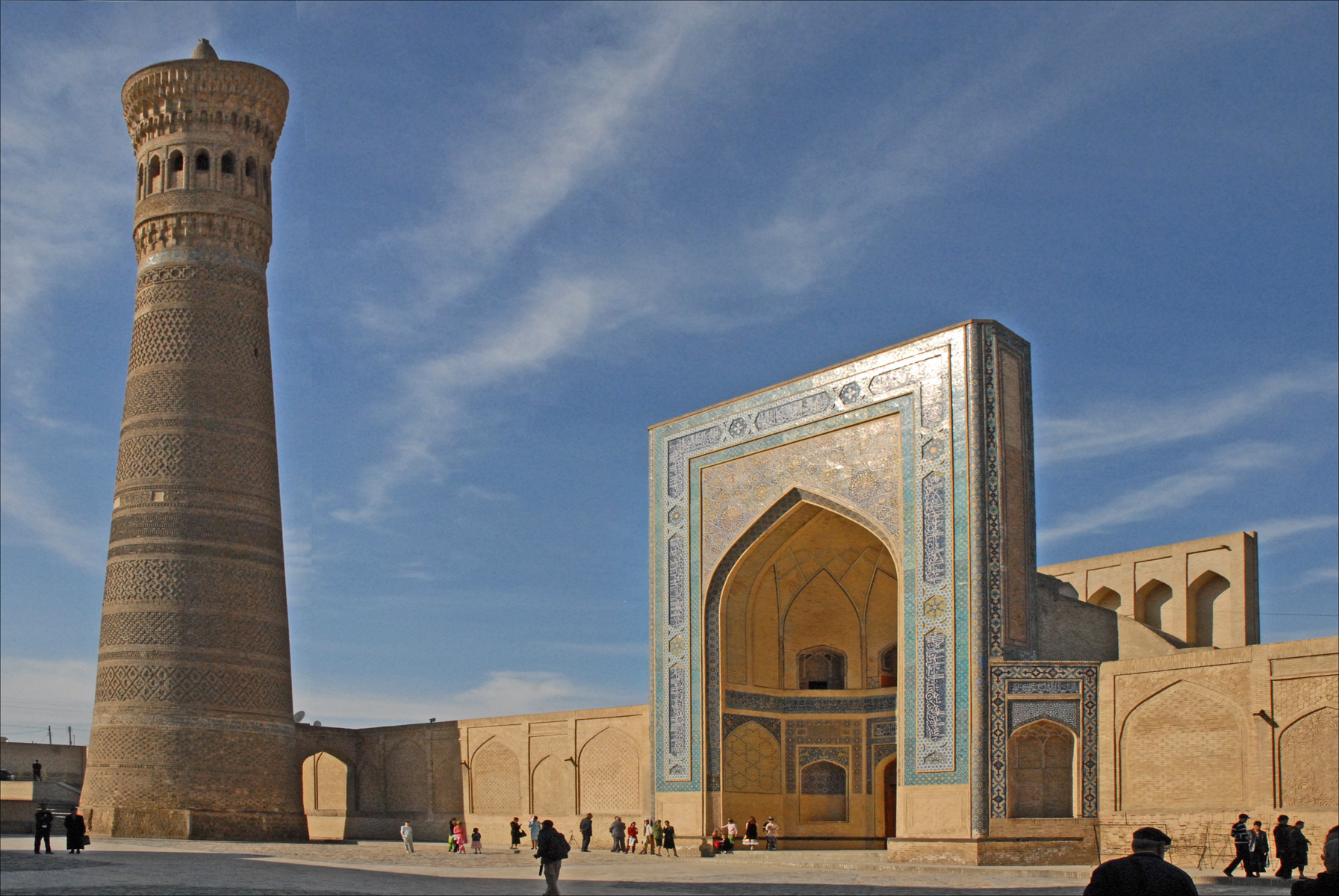
Mosque of Bukhara, Uzbekistan. March 21, 2011. Photo by Jean-Pierre Dalbéra. No changes made. View license here.
By Will Hicks

Will Hicks is an MGA1 student at the Munk School of Global Affairs with an interest in the relationship between religion and politics in Central Asia. Completing his B.A at McGill University in political science, he gained an interest in researching political change in Central Asia and Sub-Saharan Africa, and is also passionate about city planning and transportation geography. Will hopes to continue his research on Central Asia in the future, and aspires to travel to complete a study abroad semester in Kazakhstan in the fall of 2025.
Abstract: This article investigates the seemingly paradoxical relationship between religion and state in Uzbekistan. While repression of religious freedoms has existed in the state since its independence following the collapse of the Soviet Union, it has simultaneously endorsed Islam; former president Islam Karimov repeatedly celebrated Islam and its importance to Uzbek national identity and culture. I argue that the Uzbek political elites have exploited the “idea” of Islam for its nation and identity-building purposes, while also depoliticising it to prevent Islamic political movements from threatening government regimes. Applying the “religious resurgence” theory from political scientist Jonathan Fox, this paper portrays Uzbekistan as a battleground between secular and religious dynamics, with political actors attempting to secularise the very idea of religion. Importantly, the paper concludes by suggesting that the government’s current assertive approach to secularism will not last. Prolonged repression of Islam and its subsequent subordination to the private sphere may lay the foundation for political instability in the future.
Keywords: Uzbekistan, Nation-building, Islam, Authoritarianism, Soviet Union.
The authoritarian state of Uzbekistan, the most populous in Central Asia, is often considered the religious and cultural hub of the region.[1] Approximately 87-88% of the Uzbek population are Muslim, predominantly, with strong levels of piety and devotion.[2] Despite this, the country’s constitution contends that there must remain a clear separation between religion and state. Article 31 of the constitution provides the grounds to practice any or no religion, while Article 61 restricts the state from interfering in religious organizations.[3] Uzbekistan’s firm attitude towards secularism has culminated in intense religious repression, seen by the shutdown of non-sanctioned mosques and the imprisonment or death of individuals due to their religious beliefs.[4]
Almost paradoxically, however, the state has heavily endorsed Islam as a key tenet of Uzbek identity since its inception in the early 1990s following the collapse of the Soviet Union. Indeed, former president Islam Karimov often spoke about the importance of religion and Uzbekistan’s historical connection to Islam, notably stating that “human beings need spirituality like they need to breathe air and drink water.”[5] This positions Uzbekistan as a unique case in the study of religion-state dynamics, as it has consistently endorsed and engaged with Islam yet does not hesitate to carry out brutal government-sanctioned acts of religious discrimination.
Accordingly, this paper argues that political elites have a vested interest in controlling the narrative of Islam in Uzbekistan; they instrumentalise apolitical elements of Islamic identity to legitimize their secular and highly authoritarian regime. This creates a facade of religious acceptance despite the state’s intensely secular and repressive policies. This paper will first present a historical background to provide crucial historical context to its analysis, highlighting the transformation from Soviet-era policies to the contemporary policies of the state. It will then introduce scholar Jonathan Fox’s interpretation of religious resurgence theory as its theoretical framework, before presenting an investigation into the functional use of Islam in Uzbekistan.[6]
Historical Review of Islam in Uzbekistan
Islam began to spread throughout Central Asia during an Arab invasion in the 7th century and became securely established in the region’s major urban centers by around 850 AD.[7] In fact, religious and state authority in the region were traditionally intertwined, and were “merely different facets of a unified system of belief, epistemology and practice.”[8] Much of this political-legal polity was undone by Soviet policies beginning in the 1920s. Given the unwavering Soviet posture on secularism, mosques were closed and Sharia courts were abolished across Central Asia.[9] Most importantly, however, numerous major religious schools were shut down, ensuring that “the great majority of the population no longer had the possibility of gaining any sort of formal knowledge of Islam.”[10]
Uzbekistan gained independence directly following the Soviet Union’s dissolution in 1991, and its autocratic president Islam Karimov quickly realized that the state had to build a national identity from the top down to separate itself from its Soviet past. Soon after, the country began the sweeping process of “de-sovietization,” a nation-building project that sought to institutionalize “new national symbols… national heroes and national holidays” and enact a new constitution in 1992.[11] Indeed, Karimov aimed to construct national pride from scratch, heavily leaning into promoting “a sense of responsibility to the motherland.”[12] Key to his nation-building endeavors was the apparent “revitalization” of Islam in Uzbek life; he began to promote the importance of Uzbek “spirituality” and oversaw the construction of over 4000 new mosques in the country between 1989 and 1993.[13]
Yet, while this apparent religious and cultural revival may have suggested a different posture towards religious freedom than the Soviet Union’s, Karimov remained steadfast in his goal to subdue Islamic political movements by force. The crux of this tension came in 1998 with the formation of the Islamic Movement of Uzbekistan (IMU), a terrorist organization with a mandate to establish an Islamic caliphate in the country.[14] After the IMU began armed incursions into Uzbek territory, Karimov showed no hesitation to ban Islamic organizations and issue thousands arrests and beatings, only increasing the number of IMU sympathizers.[15] Following Karimov’s death in 2016, incumbent president Shavkat Mirziyoyev has since maintained the country’s inclination towards secular authoritarianism. In fact, “repression remains the means of choice [for the regime] should Islamic milieus seriously challenge the secular state.”[16] Today, Uzbekistan is considered one of the most unfree states in the world according to Freedom House, with a score of just 12/100.[17]
Examining the Literature and Deriving a Theoretical Foundation
The literature on the relationship between religion and state often compares religious and secular institutions to indicators such as globalisation, modernisation, and human development, as seen by secularisation theory or the notion of ontological security.[18] There is, for the most part, less of an emphasis in this theory-based literature on how colonial (and in this case Soviet) legacies can affect religion-state dynamics, specifically if a state gains independence from a larger country. Therefore, such existing theories in religion-state discourse are less suitable for analysing Uzbekistan.
For example, religious markets theory contends that religions can be viewed as firms competing within a state’s marketplace, with religious consumers “weighing costs and benefits and seeking the highest return on their spiritual investment.”[19] Intense state restrictions against religious freedoms indicate a closed market and therefore less religious participation, while the opposite can be said for limited state interference. While potentially practical in Western contexts, the Uzbek case challenges this conception of religion. Its highly secular system of governance would suggest a closed market with little religious participation, a pattern seen across the former Soviet republics of Central Asia. In reality however, both participation and religiosity remain high due to Islam’s cultural significance in the country. As identified by Al-Momani and Aladwan, 73% of the Uzbek population define religion as being either “rather” or “very” important in life, with 62.3% also reporting that God plays a “very important” role in life.[20]
Ultimately, this paper’s analysis of Uzbekistan derives much of its theoretical basis from the perspective of religious resurgence theory. Notably explored by Jonathan Fox, the theory contends that, on average, support and influence of religions worldwide is gradually increasing, rather than decreasing as earlier theories suggest.[21] The implications of Fox’s analysis of religious resurgence are twofold. It first demonstrates that religious support rises with religious discrimination in a country, suggesting that increasing repression can lead to resurgent religious movements. It also indicates that “every country is essentially a battleground between the supporters of secular and religious ideologies.”[22] In Uzbekistan, this manifests itself in the state’s protracted battle against fundamentalist movements as well as its constant struggle to maintain power through both force and ideology. This framework therefore provides an insightful framework for the paper’s analysis.
Uzbek Nation-Building and the Establishment of a “Secular” Islam
The notion of maintaining political legitimacy “implies a reciprocal relationship between power holders and their claims to authority in relation to subjects.”[23] Given the overwhelming proportion of pious Muslims in Uzbekistan, the promotion of Islam by the regime should, in theory, institutionalize a culture of reciprocity between the state and the public. Furthermore, the lack of hierarchy or universal leadership within Islam suggests that it is easily “manipulable,” allowing political stakeholders to use their authority to represent Muslims and their faith.[24]
Accordingly, Islam has been one of the most crucial facets of constructed some semblance of identity and nationalism in post-Soviet Uzbekistan, fostering legitimacy for the authoritarian regime. Looking to rally the public around a common ideology after the state’s independence, the incumbent regime turned to symbols, ideas, and norms of Uzbekistan’s pre-Soviet past. In doing so, President Karimov “saw Islam as a potent force for nation-building, [and] a culturally salient source of identity that could be easily tapped.”[25] As such, architecture, artifacts, and reflections of Uzbekistan’s Islamic heritage have been “of paramount importance” in maintaining state legitimacy over the last few decades.[26] Karimov’s glossy rhetoric of religion’s importance suggested a strong inclination to cater to the Muslim-majority population; he often reiterated that humanity is in a “constant, sometimes painful and arduous, search of a spiritual source.”[27] Of course, this narrative has continued to this day. Founded in 2017, the Centre of Islamic Civilisation in the state capital of Tashkent exemplifies the performative role of Islam within the country’s politics. It presents Uzbekistan “as a historical nucleus of Islamic culture” and illustrates the “contribution [of Uzbek Islam] to the development of human civilisation.”[28]
While undoubtedly “conscientious of the importance of Islam in… [fostering] public legitimacy,” the political elite have been cautious in meticulously depoliticizing Islam, the political elite have been cautious in meticulously depoliticizing Islam.[29] With the growing fear that the state could “lose control over the religion’s political impulses,” Karimov and incumbent president Mirziyoyev have manufactured an iteration of Islam that is politically dormant and functions as a secular, or even “irreligious” religion.[30] With this strategy, the elite found it imperative to “selectively cultivate those aspects of Islam that could be put at the service of state policy,” contributing to the narrative of Uzbekistan as a thriving nation-state.[31] For example, Karimov’s rhetoric on Islam depicted it as “an archaic museum-piece” which contributed to national identity yet played no role in political culture.[32] He ensured that Islam aided his claim to authority, although in its political form it remained a vestige of the past. Today, the state promotes this “Traditional Uzbek Islam” through the use of monumental buildings, art, pilgrimage tourism, and any other practice deemed not to spur political mobilization.[33] This form of Islam as a marker of cultural heritage has also been crucially distinguished from Wahhabism, which is portrayed by the state as “the Islam of the uneducated.”[34]
Ultimately, one notices that this is a reproduction of Fox’s observations, whereby the “forces of secularism prefer that religion be relegated to the private sphere.”[35] The political elite in Uzbekistan have attempted to resist the Islamization of society while exploiting Islam’s identity-building qualities, reinforcing their dominant position of secular power in the process. Of course, the state “possesses growing scope to define what religion should and should not do,” consolidating a monopoly over the Islamic narrative in the country.[36]
The Secular State: Balancing Religious Endorsement with Persecution
Fearful of Islamic movements that may threaten the secular government’s authority, the Uzbek political elite has actively undertaken coercive responses to any disobedience of this alternative form of Islam. Throughout Uzbek history, any increase in radicalization has been equally met with rising instances of persecution by the government. Even as of 2023, the Uzbek government still prosecutes Muslims based on arbitrary and ambiguous accusations, and “imposes undue restrictions on peaceful religious communities and people.”[37] The construction of an “authentic” versus “extremist” binary gives the regime a justification to discriminate against religious groups whose practices do not fit within this secular narrative, regardless of whether they share moderate or more radical values. Additionally, the pretext of alleviating this constructed sense of danger allows the secular government to “associate all political opposition with increasing Islamic radicalization,” thereby eliminating any political activity deemed threatening enough to challenge their power.[38]
However, the secular regime’s consistent battle against the Islamisation of Uzbekistan has appeared to also have led to an increase of religious mobilisation, sometimes manifesting in fundamentalist forms. In fact, the persecution of religious activists has, ironically, contributed greatly to the proliferation of fundamentalism and alternative religious dogmas.[39] Such discrimination was likely one of the primary precursors to the emergence of the Islamic Movement of Uzbekistan, which in turn allegedly produced splinter groups.[40] Accordingly, these dynamics have created a “profound division on the concept and practice of political legitimacy” in the country.[41]
This connection between religious discrimination and religious support certainly aligns with Fox’s understanding of religious resurgence. Within Uzbekistan, one could feasibly apply the theory that “religion and secularism are inevitably political competitors.”[42] More importantly, however, is the indication that persecution and repression demonstrated by the secular regime can be met by defiance from religious forces. Repression, in this case, initiates and magnifies the threat of religious insurgents that the state so desperately seeks to destroy, laying the foundations for the secular state’s gradual erosion of authority. This is directly associated with Fox’s observation that religious discrimination and support increase simultaneously. It is this state-backed “secular” model of Islam that pushes against religious forces in a protracted struggle for authority and legitimacy in the post-Soviet era.
Conclusion
The instrumentalization of Islam in Uzbekistan is a phenomenon whereby elites balance endorsing a depoliticized Islam for its nation-building and regime-legitimising qualities with preventing Islamicized political movements from threatening regime security. In an effort to build public rapport, the state has highlighted Islam’s importance to Uzbek culture, yet ensured that it should be viewed only through a “secular” lens to mitigate its political potential. Individuals or communities deemed to reject this constructed narrative of Islam are met with persecution by the state, which, by proxy, can result in the emergence of Islamist movements and even radicalised armed groups.
Considering the future of Uzbekistan’s relationship between religion and state, sacrifices may have to be made by the secular government in order to maintain power and legitimacy. Ultimately, attaining a monopoly over the Islamic narrative and persecuting dissidents may be effective in the short-term, but may eventually provide the foundation for a proliferation of religious forces which will have the potential to seriously challenge the secular state.
Endnotes
[1] Andrea Schmitz, Religious Policy in Uzbekistan: Between Liberalisation, State Ideology and Islamisation (Stiftung Wissenschaft und Politik German Institute for International and Security Affairs, 2023), 5; D. N. Bakhodirovna, “The Influence of ‘Halal Tourism Standards’ in Religious Tourism Development in Uzbekistan,” Journal of New Century Innovations 28, no. 1 (2023): 136.
[2] U.S. Embassy in Uzbekistan, 2022 Report on International Religious Freedom: Uzbekistan, https://uz.usembassy.gov/2022-report-on-international-religious-freedom-uzbekistan/; Mohammed Al-Momani and Khaled Aladwan, “Religiosity and Democratization: Toward Finding a Causal Linkage in Muslim Countries,” The Arab Journal for Arts 17, no. 1 (2020): 345–366.
[3] Schmitz, Religious Policy in Uzbekistan, 5.
[4] Edward W. Walker, “Islam, Islamism and Political Order in Central Asia,” Journal of International Affairs 56, no. 2 (2003): 39.
[5] Charles Kurzman, “Uzbekistan: The Invention of Nationalism in an Invented Nation,” Journal for Critical Studies of the Middle East 8, no. 15 (1999): 88.
[6] Jonathan Fox, “Is It Really God’s Century? An Evaluation of Religious Support and Discrimination from 1990 to 2008,” Politics and Religion 7, no. 1 (2014): 4–27.
[7] Shirin Akiner, “Islam, the State and Ethnicity in Central Asia in Historical Perspective,” Religion, State and Society 24, no. 2–3 (1996): 93.
[8] Akiner, “The State and Ethnicity,” 96.
[9] Akiner, “The State and Ethnicity,” 114.
[10] Akiner, “The State and Ethnicity,” 114.
[11] Mehran Kamrava, “Nation‐Building in Central Asia: Institutions, Politics, and Culture,” The Muslim World 110, no. 1 (2020): 10.
[12] Kamrava, “Nation-Building,” 12.
[13] Akiner, “Islam, the State and Ethnicity,” 118.
[14] Walker, “Islam, Islamism and Political Order,” 37.
[15] Walker, “Islam, Islamism, and Political Order,” 36.
[16] Schmitz, Religious Policy in Uzbekistan, 1.
[17] Freedom House, “Countries and Territories,” https://freedomhouse.org/countries/freedom-world/scores?sort=desc&order=Total+Score+and+Status.
[18] Klodiana Dhima and Matt Golder, “Secularization Theory and Religion,” Politics and Religion 14, no. 1 (2021): 37–53; Catarina Kinnvall, “Globalization and Religious Nationalism: Self, Identity, and the Search for Ontological Security,” Political Psychology 25, no. 5 (2004): 741–765.
[19] Laurence R. Iannaccone, “Religious Markets and the Economics of Religion,” Social Compass 39, no. 1 (1992): 123.
[20] Al-Momani and Aladwan, “Religiosity and Democratization”, 12–13.
[21] Fox, “Is It Really God’s Century?” 4–27.
[22] Fox, “Is it Really God’s Century?,” 22.
[23] Mariya Y. Omelicheva, “Islam and Power Legitimation: Instrumentalisation of Religion in Central Asian States,” Contemporary Politics 22, no. 2 (2016): 146.
[24] Omelicheva, “Islam and Power Legitimation,” 146.
[25] Kamrava, “Nation‐Building in Central Asia,” 16.
[26] Schmitz, Religious Policy in Uzbekistan, 18.
[27] Kurzman, “Uzbekistan: The Invention of Nationalism,” 88.
[28] Schmitz, Religious Policy in Uzbekistan, 18–19.
[29] Shahram Akbarzadeh, “The Islamic Dilemma in Uzbekistan,” in Islam and Political Legitimacy, ed. Shahram Akbarzadeh and Fethi Mansouri (London: Routledge, 2003): 91.
[30] Kamrava, “Nation‐Building in Central Asia,” 16.
[31] Schmitz, Religious Policy in Uzbekistan, 9.
[32] Kurzman, “Uzbekistan: The Invention of Nationalism,” 89.
[33] Schmitz, Religious Policy in Uzbekistan, 6.
[34] Schmitz, Religious Policy in Uzbekistan, 9.
[35] Fox, “Is It Really God’s Century?” 22.
[36] Schmitz, Religious Policy in Uzbekistan, 21.
[37] Human Rights Watch, “Uzbekistan: Backsliding on Religious Freedom Promises,” June 7, 2023, https://www.hrw.org/news/2023/05/24/uzbekistan-backsliding-religious-freedom-promises.
[38] Omelicheva, “Islam and Power Legitimation,” 156.
[39] Schmitz, Religious Policy in Uzbekistan, 10.
[40] Schmitz, Religious Policy in Uzbekistan, 10.
[41] Akbarzadeh, “The Islamic Dilemma in Uzbekistan,” 99.
[42] Fox, “Is It Really God’s Century?” 22.
References
Akiner, Shirin. “Islam, the State and Ethnicity in Central Asia in Historical Perspective.” Religion, State and Society: The Keston Journal 24, no. 2–3 (1996): 91–132. https://doi.org/10.1080/09637499608431733.
Al-Momani, Mohammad, and Khalid Aladwan. “Religiosity and Democratization: Toward Finding a Causal Linkage in Muslim Countries.” The Arab Journal For Arts 17, no. 1 (2020): 345–366. Available at: https://digitalcommons.aaru.edu.jo/cgi/viewcontent.cgi?article=1111&context=aauja/
Bakhodirovna, Djurayeva Nafisa. “The Influence of ‘Halal Tourism Standards’ in Religious Tourism Development in Uzbekistan.” Journal of New Century Innovations 28, no. 1 (2023): 135–139. Available at: https://newjournal.org/new/article/view/5950.
Dhima, Kostanca, and Matt Golder. “Secularization Theory and Religion.” Politics and Religion 14, no. 1 (2021): 37–53. https://doi.org/10.1017/S1755048319000464.
Freedom House. “Countries and Territories.” Accessed 12 March 2025. https://freedomhouse.org/countries/freedom-world/scores?sort=desc&order=Total+Score+and+Status.
Fox, Jonathan. “Is It Really God’s Century? An Evaluation of Religious Support and Discrimination from 1990 to 2008.” Politics and Religion 7, no. 1 (2014): 4–27. https://doi.org/10.1017/S1755048313000230.
Human Rights Watch. “Uzbekistan: Backsliding on Religious Freedom Promises.” 7 June 2023. https://www.hrw.org/news/2023/05/24/uzbekistan-backsliding-religious-freedom-promises.
Iannaccone, Laurence R. “Religious Markets and the Economics of Religion.” Social Compass 39, no. 1 (1992): 123–131. https://doi.org/10.1177/003776892039001012.
Kamrava, Mehran. “Nation‐Building in Central Asia: Institutions, Politics, and Culture.” The Muslim World 110, no. 1 (2020): 6–23. https://doi.org/10.1111/muwo.12315.
Kinnvall, Catarina. “Globalization and Religious Nationalism: Self, Identity, and the Search for Ontological Security.” Political Psychology 25, no. 5 (2004): 741–765. https://doi.org/10.1111/j.1467-9221.2004.00396.x.
Kurzman, Charles. “Uzbekistan: The Invention of Nationalism in an Invented Nation.” Journal for Critical Studies of the Middle East 8, no. 15 (1999): 77–98. https://doi.org/10.1080/10669929908720151.
Omelicheva, Mariya Y. “Islam and Power Legitimation: Instrumentalisation of Religion in Central Asian States.” Contemporary Politics 22, no. 2 (2016): 144–163. https://doi.org/10.1080/13569775.2016.1153287.
Schmitz, Andrea. Religious Policy in Uzbekistan: Between Liberalisation, State Ideology and Islamisation. Stiftung Wissenschaft und Politik German Institute for International and Security Affairs, 2023. Available at: https://doi.org/10.18449/2023RP08.
US Embassy in Uzbekistan. “2022 Report on International Religious Freedom: Uzbekistan.” Accessed 17 January 2025. https://uz.usembassy.gov/2022-report-on-international-religious-freedom-uzbekistan/.
Walker, Edward W. “Islam, Islamism and Political Order in Central Asia.” Journal of International Affairs 56, no. 2 (2003): 21–41.