

By Özgür Özdemir
ISTANBUL, Spring 2021
Hintz, Lisel. (2018). Identity Politics Inside Out: National Identity Contestation and Foreign Policy in Turkey. Oxford University Press.
One of the most significant variables to deploy for examining foreign policy is domestic politics. Lisel Hintz’s book, Identity Politics Inside Out: National Identity Contestation and Foreign Policy in Turkey, explores the complex relationship between national identity contestation and foreign policy in Turkey. Hintz emphasizes the significant role of domestic factors in shaping foreign policy decisions. She argues that foreign policy is not driven solely by national interests in terms of geopolitical or material power, as realists often suggest. Instead, she shows how foreign policy can be used as a tool to achieve specific political goals within a country. Internal factors, such as identity and its political actors, can represent a wide range of institutions. These include the military, courts, the education system, language institutions, legal document (i.e., the Constitution), and the media. These elements play a crucial role in shaping a nation’s foreign policy decisions.


Turkish flag waving outside the Blue Mosque in Istanbul, 2009. Photo: Jeremy Vandel/Flickr. No changes were made. View license here.
The book has an excellent academic design which clearly describes the methodology, theoretical framework, and its relevancy. As sources, the book utilized archives, surveys, social media, and television programs. Its chapters are coherently structured, each outlined carefully in the introduction, and effectively interconnected. Although the book is thorough, its detailed structure, with clues in each chapter to remind the reader the important concepts, allows for easy navigation and reading of any chapter without the need to refer to others. However, we can note the issue of repetition, which creates a problem for the readers who would like to read the book from beginning to end. Although repetition can be a common feature of academic writing, it can detract from the reader’s experience.
It is also worth underlining that despite being a relatively short volume, the book diligently reflects the historical context of Turkish politics. It deploys a constructivist framework, therefore making the context a crucial component of the analysis. The composition of a state’s identity is depended on its construction of culture, norms, ideas, and their meanings. Accordingly, Hintz puts emphasis on the malleable nature of identity while providing the required information for those who are not familiar with Turkey’s political history.

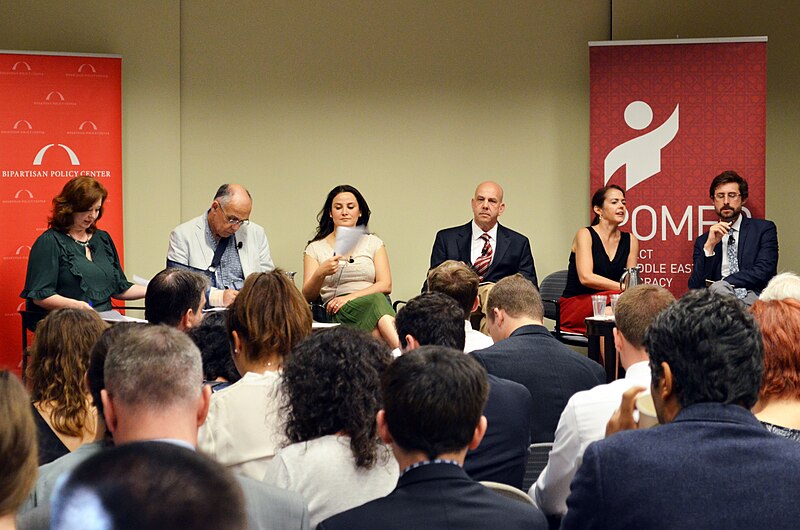
Amy Hawthorne, Henri Barkey, Gönül Tol, Howard Eissenstat, Lisel Hintz, and Nicholas Danforth participate in a panel discussion on Turkey’s elections co-hosted by POMED and the Bipartisan Policy Center. Photo: POMED/Wikimedia Commons. No changes were made. View license here.
Identity Politics Inside Out is an attempt to turn “the concept of identity politics inside out.” In other words, the author develops a theory of inside-out identity contestation. The inside-out identity contestation theory posits that when actors face challenges to their identity efforts within their own country, they will turn to the international stage to promote a specific identity agenda. This theory emphasizes the importance of international actors in shaping domestic identity politics. In her book, Hintz uses Turkey as a case study to demonstrate the broad applicability of her theoretical framework. In the penultimate chapter, she briefly mentions other cases such as Israel and South Africa to illustrate how her framework can be used to analyze national identity contestation and foreign policy in various contexts.[i] The application of the theory to other cases is minimally useful because, unlike the detailed examination of the Turkish context, these cases are only evaluated with a limited number of examples. This approach creates confusion rather than clarifying the theory, as it lacks depth and thorough analysis. To enhance clarity and applicability of the theory, the author could have provide more detailed case studies or comparative analyses that delve deeper into the specific contexts of each case. Indeed, the author could apply the theory in another study, focusing specifically on the cases mentioned (Israel, South Africa, etc.), to provide a more comprehensive analysis and demonstrate the theory’s applicability across various contexts. This would clarify the theory and strengthen its validity by showcasing its effectiveness in diverse settings.
The book extracts four main identity proposals with an intertextual approach and makes use of interviews, surveys conducted with students, social media material, government archives, novels, television programs, and many other types of texts. These four main identities are: Ottoman Islamism, Republican Nationalism, Western Liberalism, and Pan-Turkic Nationalism. They do not correspond to specific political parties and are not fixed in nature. For example, a politician from the Republican People’s Party (CHP) may carry a Western Liberalist identity. CHP has a historical association with the establishment of the Republic of Turkey and the promotion of secularism, nationalism, and modernization. These principles were central to the vision of Mustafa Kemal Atatürk, the founder of the Turkish Republic, who sought to redefine Turkey’s national identity and its relationship with foreign powers after World War I. However, it is important to note that supporters of the Justice and Development Party (AKP) typically adhere exclusively to Ottoman Islamism, at least publicly, contrasting with followers of the CHP who may have different identities. There are also some overlapping aspects among identities. For instance, a movement may embody similar norms of membership and behavior but hold contradictory cognitive worldviews. Hintz proposes a general framework with her approach, rather than claiming that these proposals capture reality perfectly. This framework aims to provide a theoretical lens for understanding the various identity proposals that exist. She utilizes a method from Rawi Abdelal’s Measuring Identity to distill these identity proposals. According to this method, constitutive norms, relational meanings, social purposes, and cognitive worldviews shape identity.[ii] She puts her rich sources into context by applying these criteria. Diverse examples, from television shows to historical facts, make it easier to understand and visualize the specificity of each identity proposals. For example, to reflect the constitutive norms of Ottoman Islamism, she points to cooking shows. In these shows, people act like alcohol does not even exist. Since television is regulated by Ottoman Islamists, it reflects their constitutive norms. However, novel and film examples are not as adequate as they claims to be. The book analyzes hit films and lesser-known works, such as Selam (Greetings of Peace) and Filinta, with a superficial approach that lacks genuine film or novel analysis.


Meeting of the Justice and Development Party in Turkey. Photo: Randam/Wikimedia Commons. No changes were made. View license here.
There are numerous scholarly sources that examine identities in Turkey. The book does not use these existing identity categories, and rather creates its own framework. Extracting these four identities rather than simply relying on previous academic literature makes it easier to contextualize their meaning for Turkish conditions. Thus, it serves as a very useful guide to understand what the book refers to when it mentions Republican Nationalist or Ottoman Islamist.
The book introduces the concept of “red lines,” which are proposals made up of components that are mutually intolerable, leading to intense contestation and intolerance. Red lines serve to sharply divide various identity proposals and oppose unacceptable proposals from other identities. For example, a red line for a Pan-Turkic Nationalist is the recognition of Kurdish identity. The red lines do not only create ideational obstacles but also put practical barriers against alternative proposals (for example, institutions, education systems, or media).
The contest among these proposals take place with the purpose of each identity creating their own identity hegemony. The struggle is not just to implement the foreign or domestic policies according to a particular identity (with a rational perspective) but also the passion and desires or “ontological needs” are the drivers to pursue hegemony. The author describes identity hegemony as a spectrum, ranging from the sense of security gained when one’s own understanding of identity is acknowledged as correct by others, to the strategic benefits derived from controlling institutions that shape beliefs about identity, such as the media and education system. Such an analytical approach is imperative because it serves to grasp the hidden tendencies behind foreign policy decisions rather than simply deploying a rational choice cost-benefit analysis.
The main idea of the book is that supporters of these distinct identity proposals take their fight “outside” which refers to the international arena. For example, in pursuit of Ottoman Islamist identity hegemony, the AKP utilizes European Union democratization reforms. International organizations, non-governmental organizations (NGOs), diaspora communities, or other international means serve as tools to become hegemon “inside.” For instance, the democratization reforms mandated by the EU allowed the AKP to reduce the political influence of the military and alter the composition of the Constitutional Court. The author uses process tracing to map the mechanisms in which these contestations take place.
She starts the story from the very beginning with the Republican Nationalist struggle for identity hegemony. The author gives the historical background for the new Republic and shows how Republican Nationalists have initiated the construction of their own visions, grounded in secularism, modernism, and nationalism. It is unclear whether they also used foreign policy to establish internal hegemony, with the aim of disseminating their own proposal for national identity throughout the population. However, the author provides a comprehensive historical backdrop for understanding the evolution of Republican Nationalist identity by brilliantly summarizing a wide variety of events from the Turkish Independence War to the Surname Law.
Another important date she delves into is the military coup of 1980. She emphasizes the increase of the contestation between Republican Nationalism and Ottoman Islamism after the coup. Turkish-Islamist synthesis was a project to diminish the effects of the left and marked a violation or a concession of Republican Nationalist red lines. After the end of Cold War, Turkey tried to build closer ties with Turkic states in the Caucasus and Central Asia. This foreign policy stemmed from Pan-Turkic Nationalism’s relational meaning. Again, a red line of retaining Western orientation was overstepped. Western Liberalists were also actively working to influence others in issues like Kurdish question or human rights issues.
Another crucial period is 1990s. Republican Nationalism has been the biggest obstacle for Ottoman Islamism because it has already institutionalized red lines. Hintz puts emphasis on three important institutions in this sense: Turkish Armed Forces (TSK), the Constitutional Court and university rectorship. She underlines the efforts of the Welfare Party (RP) to spread its identity hegemony, but being blocked by these aforementioned institutions. She especially gives examples from the incidents of the February 28, 1997 process which were a reaction against the Erbakan government. She gives these examples as important challenges to Republican Nationalist hegemony. In this process, TSK interfered with Ottoman Islamist RP with directives, after which the Constitutional Court closed the party. Finally, with this push, university rectors with Islamist tendencies were removed.
Successor of the 1990s Ottoman Islamists, Justice and Development Party (AKP) came into power in 2002. Since AKP’s politicians learned from previous experiences, they did not try to implement their own agenda. Instead, they focused on overcoming the institutional obstacles first. AKP showed its willingness to join the European Union (EU) in order to overcome these red lines of TSK, Constitutional Court and university rectorships. This foreign policy orientation became a legitimization tool for domestic reforms in the military and judiciary sector, among others. Democratization was an excuse to reduce the dominance of military with cases like Ergenekon and Balyoz[iii]. Furthermore, it was a reason to change the composition of the Constitutional Court. The proposal was to increase the number of regular justices from eleven to seventeen, which appears to be in line with EU norms that limit justices’ terms to twelve years. This maneuver enabled the AKP to replace justices appointed by the previous Republican Nationalist president Sezer with those who are more aligned with the AKP’s views.
Finally, AKP was successful in winning the contest against the red lines of the status quo with its international efforts during the 2000s. In the 2010s came the time for the initiation of Ottoman Islamist hegemony. New domestic and foreign policies became more oriented toward Ottoman legacies. This new identity hegemony permeated all realms of daily life: Islamic symbols became dominant in the public sphere; foreign policy reoriented toward Muslim countries and their leaders; the West became the new enemy and closer relations developed with former Ottoman territories; and the media began being controlled by the Ottoman Islamists.
As a result of their external challenges and contests, Ottoman Islamists were subsequently able to initiate the implementation of their substantive policies. Now they are institutionalizing their own red lines like the norms of Sunni Islam. Hintz, however, puts emphasis on the previous success of Republican Nationalist hegemony, which has been overcome by the AKP. She argues that their hegemony has become more influential than others and, to support her argument, gives the example of Gezi Park protests as a hybrid identity proposal, demonstrating that Ottoman Islamist hegemony is a fragile one.
The potential bias of the narrative may be more pronounced if it were developed by a researcher residing in Turkey. However, the author’s American nationality is a distinct advantage of the book. Her outsider status lends a unique objectivity to her work, providing a valuable perspective that offers a clearer and more insightful account of the internal dynamics within Turkey.
Endnotes
[i] Lisel Hintz, Taking the Theory “Outside”: State and Non-State Actors’ Use of Inside-Out Identity Contestation, Identity Politics Inside Out: National Identity Contestation and Foreign Policy in Turkey (New York: Oxford 2018), 132-133, 137-139.
[ii] Rawi Abdelal, Measuring Identity : A Guide for Social Scientists (Cambridge: Cambridge University Press, 2009).
[iii] The series of investigations and trials known as the Ergenekon and Balyoz trials, which occurred from 2008 to 2012, stand out as significant episodes in recent Turkish history. These trials involved the prosecution of hundreds of individuals, including military personnel, journalists, and politicians. They were accused of belonging to a covert secularist organization allegedly planning to overthrow the AKP government by inciting terror in society. The cases centered on the concept of a “deep state” organization plotting to sow chaos through bombings and assassinations to justify a military coup against the democratically elected government. Initially, the Ergenekon and Balyoz trials were seen as a step towards democratization by prosecuting high-ranking figures like Kenan Evren. However, later on, they appeared to target powerful individuals and undermine the credibility of institutions opposed to the AKP. The trials’ fairness was called into question due to the use of illegally obtained or fabricated evidence, including incriminating CDs written in a font released after the alleged events. Furthermore, the significant number of Gülen movement members in influential positions within the police and judiciary who were responsible for handling the cases raised concerns about potential hidden agendas behind the trials.
References
Abdelal, Rawi. Measuring Identity: A Guide for Social Scientists. Cambridge: Cambridge University Press, 2009.
Hintz, Lisel. Identity Politics Inside Out: National Identity Contestation and Foreign Policy in Turkey. New York: Oxford 2018.